
- Location
- Gedaref · Kassala
- Period
- 20 Feb to 18 Jul 2024
- Funding and oversight
- Delivered with DT Global. Financed by USAID, the agency was dismantled and folded into the US State Department in July 2025. Oversight: Gedaref State Humanitarian Aid Commission. This was G.Artistic's second USAID-funded project.
The situation we entered
Eastern Sudan in early 2024. War-driven displacement had concentrated in Gedaref and Kassala. Host communities were absorbing more than they could comfortably carry. Health systems stretched, water access uneven, and the social fabric pulled tight by people who arrived with everything they could not leave behind.
G.Artistic was already on the ground. This was our second USAID-funded project, delivered through DT Global, with scope across both states.
How we worked
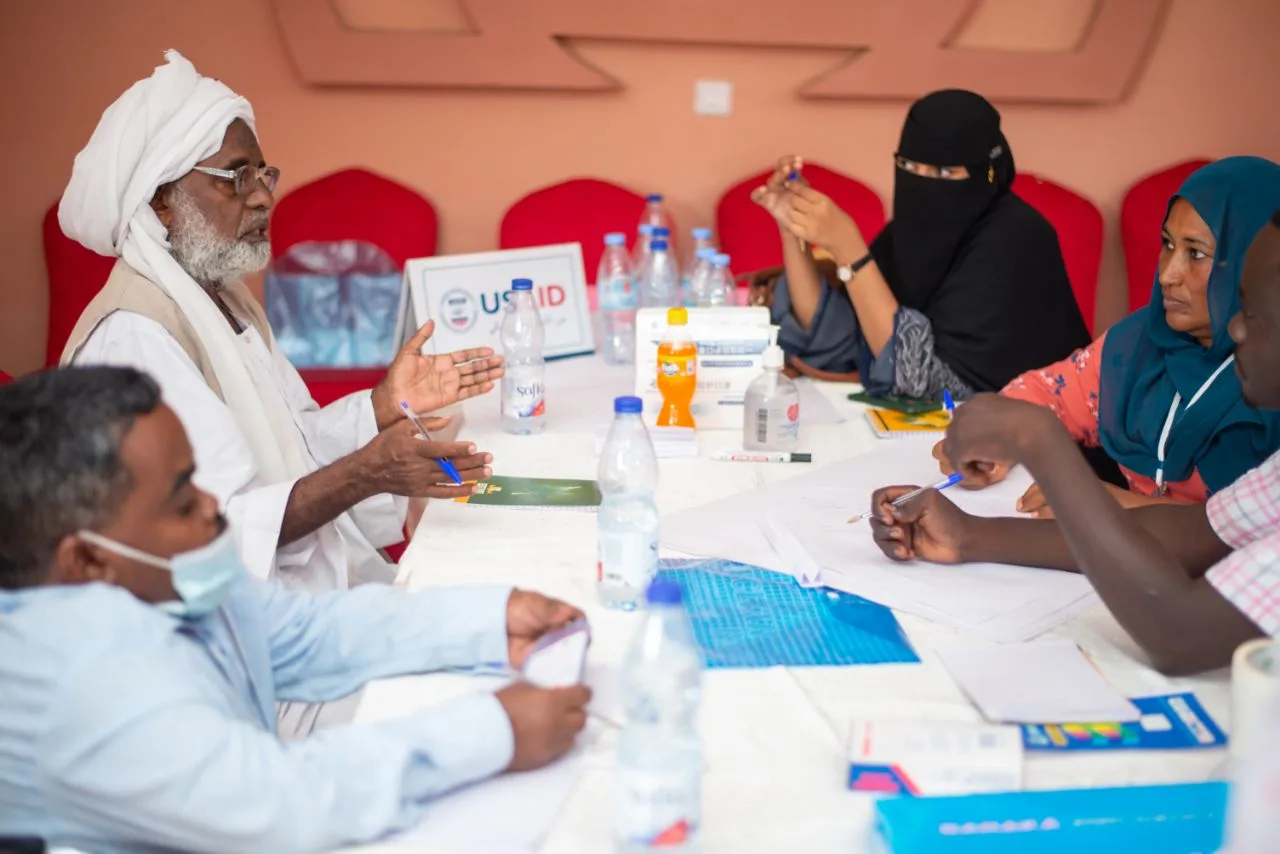
One project, four delivery tracks, running in parallel from late February to mid-July 2024. Health services, water and sanitation, arts events, and capacity training, each with its own team and its own measurement, all under the same project frame.
Arts and community events
Exhibitions, music, and theatre across both states. Four days of programming. The arts were the social meeting ground.
Health services
Static clinics in both states and mobile teams for shelter populations. Primary care, reproductive health, and mental health, for roughly two months.
Water and sanitation
Clean water trucked to gathering sites and shelter centres. Storage tanks installed where supply was most fragile.
Capacity training
Trauma-support workshops for women and children affected by the war. First-aid training for community responders. Shelter-logistics training for supervisors and emergency-response teams.
What the record shows
Every figure below was verified through post-distribution monitoring, activity registers, and field visits. The full breakdown lives in the project's final report.
12,028
Direct beneficiaries
20,331
Indirect beneficiaries
1,994
Health consultations, Gedaref
1,962
Health consultations, Kassala
97,785 L
Clean water delivered
3,400+
Arts event attendance
Direct beneficiaries break down as 3,107 men and 8,921 women. The water track served 4,611 people across seventeen gathering sites and shelter centres. The Gedaref clinic figures cover primary and reproductive health (969 visits) and mental health (1,025). Kassala: primary care (433), reproductive health (494), mental health (1,035). The capacity track ran trauma-support workshops for twenty-one participants, facilitated by twenty-one community volunteers working alongside the project's psychologists. First-aid training reached twenty community responders; shelter-logistics training reached twenty supervisors and emergency-response staff.
How we measured
Each track had its own data-collection method, layered to triangulate. Surveys captured participant experience. Focus groups and interviews surfaced what survey instruments miss. Field observations and progress reports tracked delivery on the ground. The figures above survived all four lenses.
Funding and oversight
Delivered with DT Global, our managing-contract partner on the ground. The underlying contract was financed by USAID, which was dismantled and folded into the US State Department in July 2025. Oversight throughout: the Gedaref State Humanitarian Aid Commission. This was G.Artistic's second USAID-funded project.
Counterparts
DT Global
Managing contractor
USAID
Funder (programme closed 2025)
Gedaref State Humanitarian Aid Commission
Oversight
What worked, what didn't
- Combining mental and physical health in the same clinic rotation gave people permission to ask for both. They came in for blood pressure and stayed for the psychologist. We will keep this combined model.
- The trauma support ran through twenty-one community volunteers who facilitated the workshops alongside the project's psychologists. They lived in the communities; we did not need to.
- Continuous engagement with shelter committees, not one-off visits, built the working trust that made everything else possible.
- Where we fell short: medicine ran short more than once. Security concerns in Gedaref forced rescheduling. Supplies to the Gedaref clinics arrived later than planned. Five months was a tight envelope for the depth we wanted in mental-health follow-up.